
The Intelligence Layer Ladder
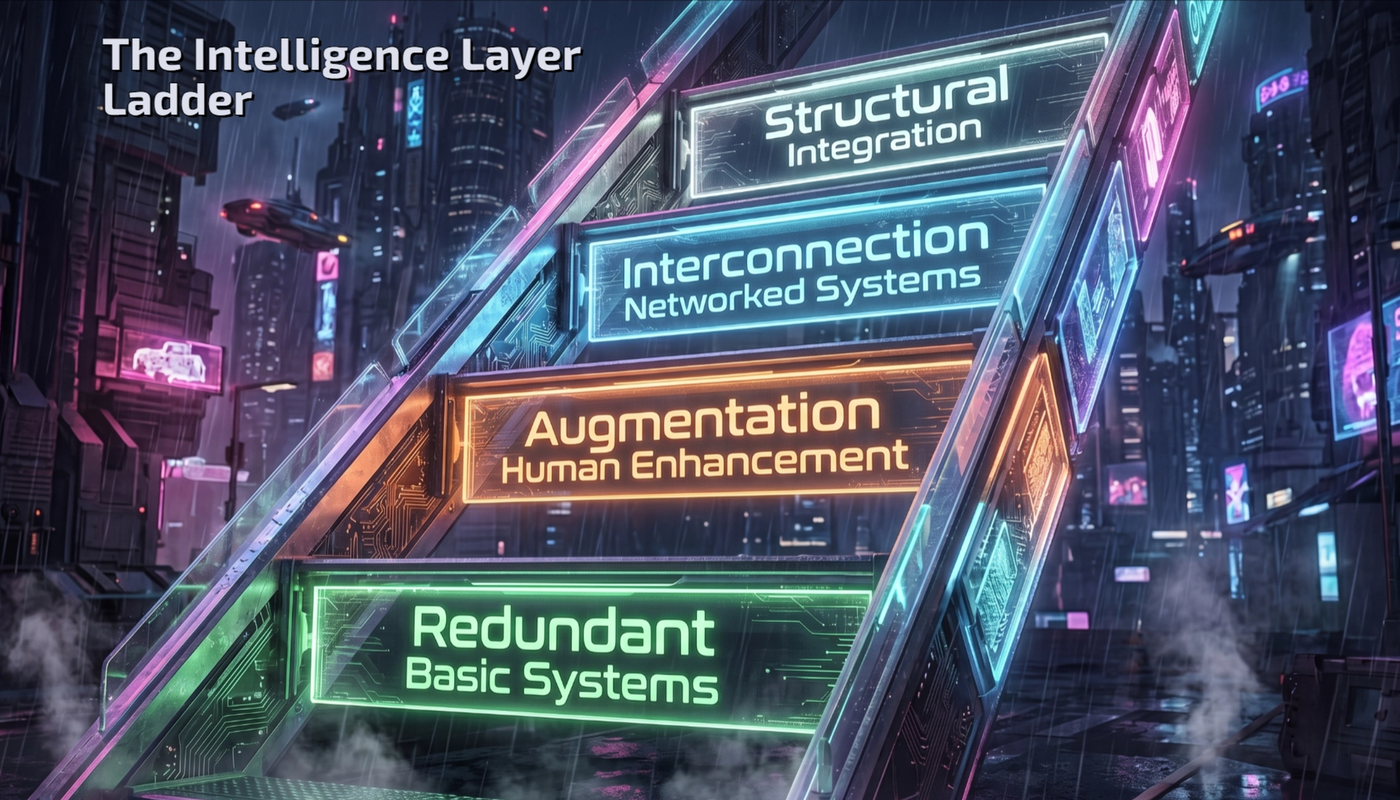
Your people are already an intelligence layer
Every organization already runs on an intelligence layer. It is made of people, who carry not only knowledge but judgment, relationships, accountability, and the unwritten context that makes a business work. The arrival of capable, low-cost AI introduces a second intelligence layer that is abundant and tireless. The common mistake is to point that second layer at the same work the first layer already does and to call the result a transformation. A second intelligence layer laid over an unchanged organization mostly duplicates the first. You end up paying twice for the same output.
The value was never in adding intelligence. It is in restructuring the work now that two layers exist. That restructuring does not happen in one leap. It proceeds through recognizable stages, and naming those stages is the entire purpose of the Intelligence-Layer Ladder. The ladder has four rungs, and the distance between standing on the bottom rung and standing on the top one is the difference between an AI program that looks busy and one that changes the numbers.
It helps to be precise about what abundance changed. Intelligence used to be scarce and expensive, so simply having more of it was an advantage. It is now cheap and widely available, which means owning it is no longer a differentiator. What stays scarce is the structure that puts intelligence to work and the human judgment that decides where it belongs. The ladder is a way of seeing how far an organization has moved from merely owning intelligence to actually restructuring around it.
Rung 0: Redundant intelligence
Hand a practicing physicist the knowledge of physics and the return is close to zero, because the knowledge is already present. Nothing the physicist produces changes. The only way the added intelligence would pay off is by replacing the physicist, and a person contributes far more than knowledge, so it cannot. A surprising amount of what is called AI adoption sits exactly here: tools that give knowledge workers faster access to knowledge they already had. The activity is real and the demonstrations are impressive, but the return on the bottom line is not, because nothing structural has changed.
Rung 1: Individual augmentation
On the next rung, an agent or automation takes over an individual's repeatable tasks. Though the value is genuine, it is where most programs that are called successful actually stop. Its limitation is structural. It scales horizontally, one person at a time, and it is capped, because individual speed does not aggregate into enterprise outcome when the surrounding structure is unchanged. A team can be measurably faster at their desks while the function they belong to shows no movement in cycle time or cost to serve, because the gains evaporate at the handoffs, queues, and approvals the function is actually built around. Faster inputs into an unchanged system produce the same output.
Rung 2: The interconnection layer
Picture every person with help riding alongside them, a sidecar. Sometimes that sidecar is an AI agent. Often it is a deterministic workflow or a piece of automation, because not every task needs a model and many are handled better by something predictable. On its own, whichever form it takes, a sidecar is still rung one: one person or one system, faster. The change arrives when the sidecars can act across boundaries, on one another's behalf, so that the coordination between people, teams, and systems, the handoffs, the waiting, the checking with, begins to collapse. This is the first rung at which value appears at the level of the function rather than the individual, because the bottleneck in most organizations is not how fast any one person or system works but how slowly work moves between them.
There is a catch that most efforts to put an agent on every desk miss. A sidecar cannot breach a communication barrier that no one has opened. Before any agent or automation can coordinate across silos, an interconnection layer has to exist beneath it: the shared rails, integrations, and contracts that let systems, workflows, and agents exchange work safely. Building that layer is the real work of this rung, and it is unglamorous infrastructure rather than another tool. Skip it and your sidecars stay trapped in their own silos, fast in place and unable to reach each other. Build it and cheap intelligence does not replace human collaboration; the connected layer accelerates it.
This distinction matters because the loudest version of the AI story treats intelligence as a replacement for people. At rung two the opposite is true. The agents and automations carry the abundant, rule-shaped work and the coordination overhead, which frees human attention for the judgment, relationships, and exceptions that only people handle well. An organization that guts its collaboration in the name of efficiency tends to lose the very thing its customers were paying for, while an organization that connects this layer around its people compounds both.
Rung 3: Structural integration
The top rung redesigns the business function around the interconnected layer. Steps disappear, merge, or move. Human roles concentrate where judgment and trust actually matter. Accountability is redrawn to fit the new shape of the work. This is where the economics change, and it is also the rung almost no one has reached, because it cannot be done from the bottom up. A user with a license can be faster at a task. Only leadership can restructure a function, redraw who is accountable, and decide what the organization will now measure. The work at this rung is organizational, not technical, and the AI is a component of it rather than the project itself.
- 0. Redundant. What it is: Intelligence handed to people who already have it. Typical return: Near zero.
- 1. Augmentation. What it is: An agent or automation takes an individual's repeatable tasks. Typical return: Real but capped.
- 2. Interconnection. What it is: A shared layer links people, systems, agents, and automations. Typical return: Step-change begins.
- 3. Integration. What it is: The function is redesigned around the connected layer. Typical return: Where the real return lives.
Why the failure headlines measure the bottom of the ladder
The widely reported finding that most enterprise AI initiatives fail to move the numbers is, read carefully, a finding about which rung organizations are standing on. The studies measure individuals given tools, which is rungs zero and one, and at that level flat returns are precisely what the ladder predicts. The conclusion to draw is not that AI does not work in the enterprise. It is that almost no one has climbed past the bottom. That is a statement about organizational immaturity, not about the technology, and for a leadership team it is an opening rather than a warning. The competitors who treat the headlines as proof that AI does not pay off will keep funding rung-one pilots and keep being disappointed. The ones who recognize the ladder will climb it.
Climbing the ladder is a top-down act
Three decisions separate the bottom rungs from the top, and only leadership can make them. The first is where accountability sits when an agent or automation enacts across teams, named to a person rather than to an abstraction. The second is how the work is re-sequenced once the new systems are connected, which steps vanish, which merge, which move. The third is what the organization measures, a function-level number rather than seat-level activity. None of these can be made by someone with a license and no mandate. Democratizing access to the tools is good, and worth doing, because it is how new ideas and new talent surface. But the decisions that turn access into return cannot be democratized. Democratize the tools; concentrate the decisions.
This is why the comfortable path, buying licenses, token sprinkling, and measuring adoption, is the popular one. It threatens no one and produces a satisfying chart. The uncomfortable path, redrawing a function and its accountabilities, is where the return lives, and it costs political capital. If an AI program has cost no one any political capital, it has probably not yet changed anything.
The bridge to durable advantage
Climbing to rungs two and three means agents and automations acting across people, groups, and systems, often on one another's behalf. That is not safe to attempt without governing the boundaries between them. This is where the Intelligence-Layer Ladder meets the Risk Priority Bridge Framework, ThreddSync's companion framework for navigating consequential transitions. The move to structural integration is exactly the kind of transition the bridge framework is built to govern, and its discipline of governance by construction, building the rules into how the work is done rather than bolting them on after an incident forces it, is what makes the climb to the upper rungs safe enough to attempt. The ladder tells you where the value is. The bridge framework tells you how to reach it without falling in.
Learn More: The Risk Priority Bridge Framework at Building Durable Advantage in an Era of Abundant Intelligence.
Questions for your leadership team
Which rung is our most-funded AI initiative actually on?
If the honest answer is rung zero or one, the program is not failing in any unusual way. It is sitting where the returns are structurally small, and the path forward is to climb rather than to buy more of the same.
Where does coordination, rather than knowledge, cost us the most time?
That answer points directly at the rung-two opportunity. The largest gains usually hide not in how fast any individual works but in the handoffs and waiting between them, which a connected layer of agents and automations is unusually good at compressing.
What would have to change structurally for our biggest AI bet to pay off?
If the answer is only more usage or more licenses, the bet is parked on a lower rung. If the answer involves redrawing accountability, re-sequencing the work, or changing what gets measured, that is the climb to rung three, and it is a leadership decision.