
The THREDD Development Paradigm - The Solidarity Principle
Teams and AI thrive when unified by shared purpose. Empathy drives cohesion, ownership, and quality. Solidarity groups purposeful threads toward intelligent decisions, bounded by Autonomy and enabling Compositionality.
When we begin to realize autonomous teams we truly begin to move in unison and for a common interest and goal. The development of ideal products and services that will more than satisfy your customer base and keep them wanting more. In today's world your products need to tell a story. One that engages your potential customers instilling a meaningful reason for choosing you amongst the sea of affluent other choices. As much as you focus on the uniqueness of your brands and features this isn't always enough to convince a potential buyer. The same is true inside your organization. We want to attract team members that believe in the very idea they are giving up so much of their day to contribute to. We want them to feel connected to it and even during interviews a commonly asked question is, "why do you want to work here?". Which bring me to the fourth principle of the THREDD AI Paradigm, the Solidarity Principle, in the team dynamics domain.
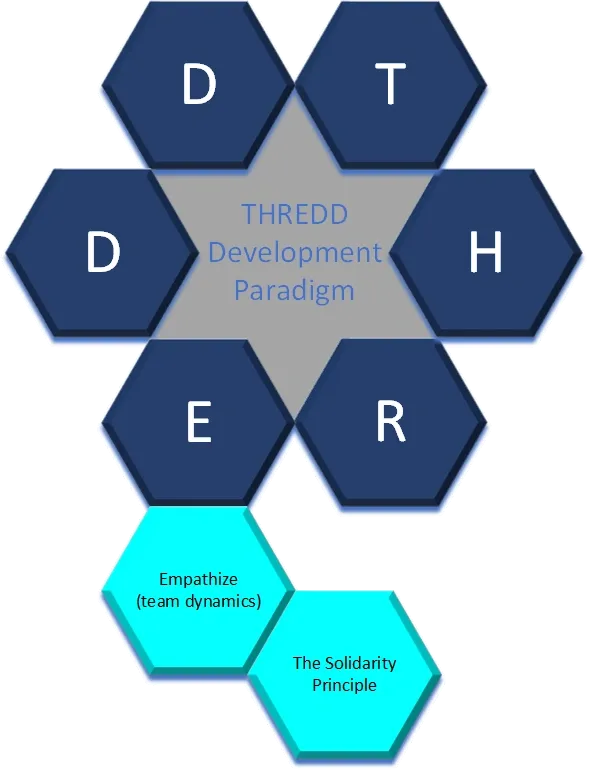
It’s important for a team and its members not to feel like cogs in a machine. Their ideas and suggestions need to be heard. After all, their goal is also your goal and building in a sense of ownership goes a long way. In order to achieve a state of solidarity, we must 'EMPATHIZE'. When we begin to lose sight of the purpose and value in what we are doing, the quality of the result suffers. The attitude that often follows can grow into some of the most toxic environments, eliminating any hope of a tolerable workplace. This breeds organizations with high attrition rates. What's worse is those that lost site of the purpose will likely come to terms with it and stay unless let go, while the driven will leave to find new purpose. There is a phenomenon occurring in business today where those who can, for many different reasons, move on, leaving back those who can't. Over time, this results in those organizations being left with mediocre talent, which leads to mediocre decision making, mediocre products and services, all because of mediocre productivity. You need your own people to buy into your story just like you need your customer to, the difference being that you aren't going to pay your customers.
Purpose is a cornerstone for any unsupervised learning AI. This is because though we start from well trained, well defined, supervised learning models the AI must have the ability to integrate new information and improve upon its own process. It would not be efficient, however, to integrate any new information, unless it aided its purpose. It would not be beneficial to spend my training time acquiring knowledge about how to fix a car If I want to learn how to build a house. Though, some of the skills may be transferrable, such as similar electrical wiring, window setting, HVAC systems, as well as other topics, it is important to discern the associated information and compartmentalize understanding so it can contribute to purposeful decisioning.
Solidarity in the THREDD AI Paradigm represents the cohesion and grouping of THREDDs, or associated threads of learning, that contribute to an intelligent and purposeful decision. In the application of this paradigm to software development methodology, the THREDDs represent the individuals purposefully working together toward a common goal.
The Solidarity Principle is limited by the Autonomy Principle and benefits the Compositionality Principle.
In other words the ability to 'EMPATHIZE' is limited by the ability to 'RESPOND' and facilitates the ability to 'DISCOVER'.