
The THREDD Development Paradigm - The Predictability Principle
Productivity is measured by goals, not process. The Predictability Principle demands continuous goal-oriented evaluation, standardizing outcomes to build reliable benchmarks.
The culmination of integrating an effective product strategy-driven approach lies not just in its measurability, but in the predictability of itself as an efficient decision making engine. It is an important distinction to understand that evaluating your productivity is not about evaluating how well you have implemented your process. This is often done today as most processes come with their own built in evaluation metrics. How can it be that these pre-determined evaluation metrics measure your companies product strategies and goals. For example, team velocity in agile scrum is not a measure of productivity, but a measure of efforts of work which require other measurements to determine. Therefore, team velocity is a measure of measures. Capacity planning becomes a measurement of the measure of velocity on top of the measure of efforts of work. There is not even a productive way to explain that sentence. Productivity is not the measure of the sum of the productivity of its composite components, of which mostly time is the biggest factor. The Predictability Principle states that measuring a decision making engine can only be drawn from a measure of its predictability.
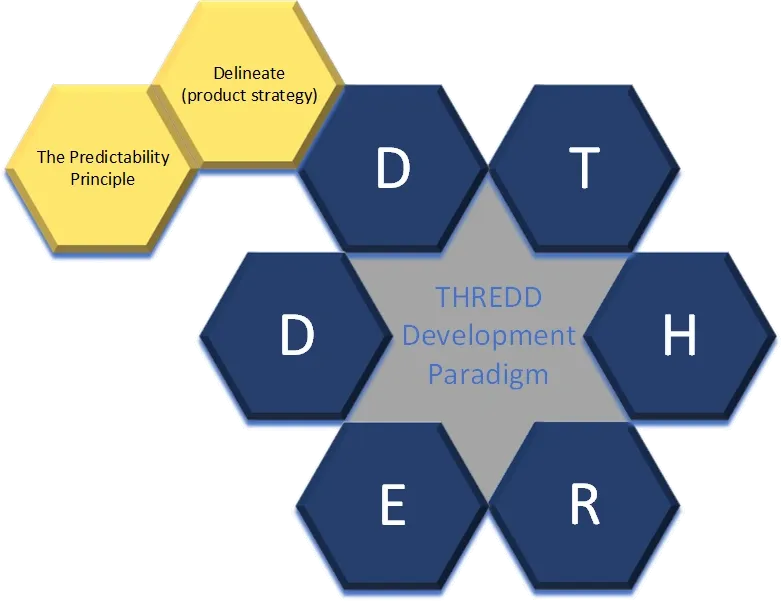
How would you measure the time it takes to increase your product subscriber base by 24%. No amount of capacity planning or team velocity metrics can measure this. This is because in actuality it is a consistent optimization problem, of which your current approach will yield some result. Whatever the result in time, effort, resources, spent to onboard 24% more subscribers, if I continue to do the same, I will achieve the same output. Evaluation of these individual metrics do not matter. It is the strategic approach which needs to continuously be evaluated. How can I trust this process? 'DELINEATE'. Remember your product strategy is your goal, so start measuring those goals, not your process. Measuring your process will divert your efforts to improving the process itself and not improving the predictability of achieving your current and future goals. If in order to reach a goal of 24% in 1 year, you may need to achieve a 2% growth rate in each month. If your team works hard for a single month, achieves the 2%, sits back for 11 months, and each successive month this growth continues at a 2% rate, you might think the team was only productive in the first month. I would tell you, you're wrong and you have just evaluated your process. The team was actually equally productive in each month of the year. Let's look at this another way. Take the work done in that single month, and divide it by 12. Now assume it takes the entire year of working, with no vacation, to complete this amount of work and the end result was a 24% increase in the subscriber base. Which team would you say was more productive? The answer is, both were equally productive because both achieved their goal. Suggesting the first team wasted 11 months of your time is an evaluation of your process, not of your goals. The first team may have developed a component that relied on accumulation of new data over time, whereas the second team succumbed to a multitude of connectivity and communication boundaries continuously delaying their efforts. In either case, setting clearer boundaries and standards will allow predictability the next time this task is required and improving upon this becomes a baseline. Bounding and standardizing the work the first team completed within the first month will allow you to recover unused time or even understand why it was necessary to allow this feature to slowly take effect. There is no single measure of productivity, the measurement will evolve as you subsequently iterate with your team. Your benchmarks may change after you achieve them. If next year your strategy changes to aim for a 30% growth rate, you now know you need to make changes and you can't rely on your current approach.
It is essential to continuously refine your teams approach with compositional data and feedback to make sure you accurately perceive predictability. This is self-evaluation on whether you are progressing closer to achieving our goal and this is not something that can be achieved by evaluating process and ceremony.
The Predictability Principle is limited by the Compositionality Principle and realizes a most accurate measurement of productivity.
In other words the ability to 'DELINEATE' is limited by the ability to 'DISCOVER' and facilitates a consistent optimization approach to productivity