
The THREDD Development Paradigm - The Connectivity Principle
The Connectivity Principle reframes teams as mesh networks, not hierarchies, enabling free information flow, decentralized decisions, and alignment through real-time interaction rather than rigid process.
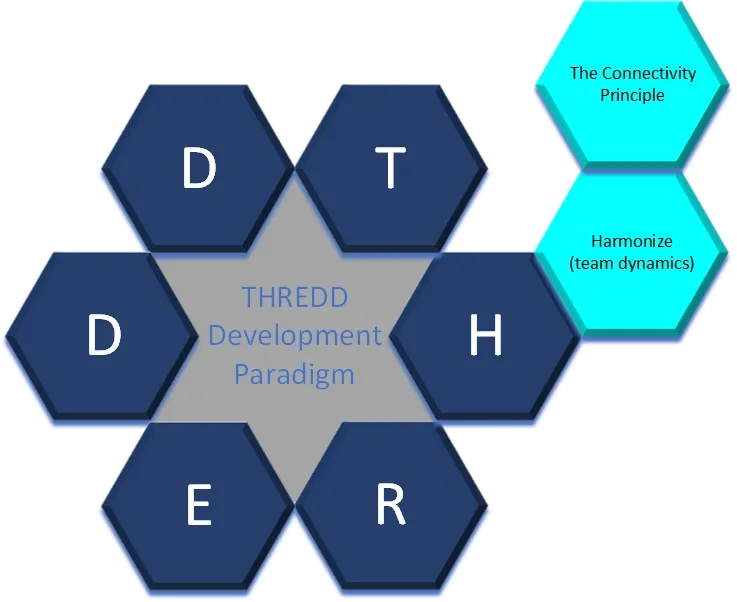
The second principle of the THREDD AI Paradigm is the Connectivity Principle under the domain of team dynamics. The best metaphor I can think of to illustrate this concept is a mesh network. For reference, a mesh network is a topology where nodes connect directly, dynamically and non-hierarchically to each other. A property of mesh networks is that they dynamically self-organize and self-configure. This is the exact opposite of the use of process. The guiding action here is 'HARMONIZE'. As members change out, your team grows or shrinks, priorities adjust, and you learn more about your goals, your teams will also need to do just that. Dynamically self-organize and self-configure. The best way to facilitate this is to break down communication hierarchies and boundaries. If you manage others, stop thinking of yourself as their boss. If you are an engineer, your boss is not your manager. Remember, in hierarchal structures people work for other people. This thinking is the manifestation of process, and process will mislead you most egregiously.
In order for an intelligent agent to make a decision it is not enough for it to know what information it needs, but it must be able to access that information from whomever the most valuable sources are, wherever they can be found and at any moment it is needed. This might include your customer, a product designer, an architect, a co-engineer, etc. Open communication is the best way to facilitate this and diverse team structures that have key decision makers present and accessible will drive productivity.
The Connectivity Principle is the foundation of any organizational team. Huge amounts of resources are spent by companies making efforts to align their initiatives with their companies vision, but how did it get out of alignment in the first place? A lack of connectivity... A problem that cannot be fixed by disseminating documents of information and forced training sessions for all staff.
Another characteristic of a mesh team structure is the larger the team grows the more lines of communication there are. This will undoubtedly expose the pressure of process boundaries and their effect on the teams ability to move quickly. If the team is slowing down, this a sign that you may have too many members. Software teams do not need to be large. A team of only 10 can move just as fast as a team of 50. In my own experience I have outpaced much larger teams five to eight times in size with small groups working on sometimes even more complex tasks. As team size increases, there is an exponential growth in management necessity and a requirement to enact more rigid process to maintain visibility and further identify inefficiency in that very process itself. This is time spent not focusing on your goal, but laying more deeply rooted foundations to which goals can 'possibly' be achieved on top of. This thinking is backwards and inorganic, as productivity becomes a measure of the process and not of the achievement of the members of your teams.
We need to start looking at our goal as our boss, together. Only then can we all move in harmony.
The Connectivity Principle is limited by the Ascendency Principle and benefits the Autonomy Principle.
In other words the ability to 'HARMONIZE' is limited by the ability to 'TRAIN' and facilitates the ability to 'RESPOND'.