
The THREDD Development Paradigm - The Compositionality Principle
Intelligence grows by connecting existing knowledge to new information without being told how. The Compositionality Principle fosters discovery, building new models from existing ones to optimize decisioning processes.
In mathematics and language, compositionality states that the meaning of a complex expression is determined by the meanings of its constituent expressions and the rules used to combine them. As we 'TRAIN', 'HARMONIZE', 'RESPOND', and 'EMPATHIZE', two important steps still remain in our paradigm. The first is how the integration of new learnings effects the end result, or how we 'DISCOVER' correlations in how our actions contribute to the common goal, ultimately in making an accurate, yet productive, decision.
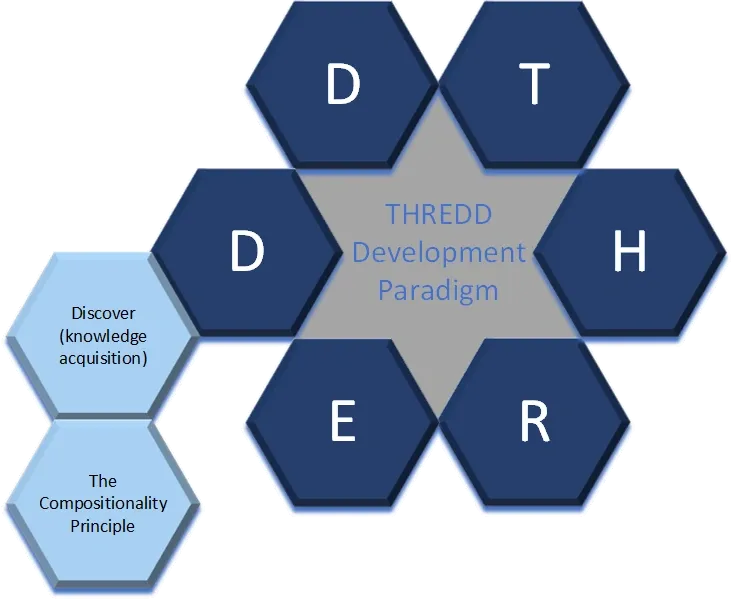
The Compositionality Principle in the THREDD AI Paradigm states that the intelligence must be able to conceptualize new models from the components of existing ones without external feedback. It is a much less complicated problem to build all possible combinations of THREDDs successively as new information and THREDDs are created. Then evaluate them with respect to the goal. The far more complicated task is how to associate new information without being informed about what that new information is useful for.
Take the previous example of an intelligent agent that is capable of determining that you have run out of milk. If you recall, the process to be followed was to check if there are 5 dollars in your wallet, then go to the grocery store, purchase the milk, carry it home, and store it on the second shelf in the door of your refrigerator. Now suppose during its drive to the grocery store, the radio is playing and a commercial advertises a financial app with some arbitrary personal money management features. At this present time, this new information does not help the agent follow through with the process of retrieving the milk. The task gets completed, the milk is purchased and brought home and assuredly, the household members will be able to enjoy their cereal the next morning, Barring, of course, that they are not also out of cereal, but that is not the point, or is it? Later, new information is learned again, in which the household members use an application to manage their personal finance. It now becomes apparent to the agent that the first step in the milk purchasing process could be optimized by checking whether 5 dollars exists in the apps household account instead of searching for paper money in a physical wallet. Does this help? The process of purchasing milk can now be improved. Furthermore, suppose the household is now out of cereal, and the only reason for purchasing milk was to complete a breakfast routine. You can see how composition of new information can aid in the productivity of the goal, but this is not the difficult part. The complexity lies in human ability to analyze the hypothetical, and even further to generalize information to apply it to other tasks and decisions. Knowledge acquisition is not just about being taught, but also lies in the exploratory manner of thinking. How does your organization foster this type of activity? The way to incorporate this principle into your development process is to provide mechanisms for discovery to occur. Some organizations achieve this by hosting hackathons, or even providing recognition and awards for discovering new methods. What better way to reap the benefits of the valuable resources that you have across your teams. Through driving the previous principles, you have been building experts and evangelists in your organizations way of thinking using the tools of ascendency, connectivity, autonomy, and solidarity with one another.
The Compositionality Principle is limited by the Solidarity Principle and benefits the Predictability Principle.
In other words the ability to 'DISCOVER' is limited by the ability to 'EMPATHIZE' and facilitates the ability to 'DELINEATE'.