
The THREDD Development Paradigm - The Autonomy Principle
Autonomous teams execute without gaps in knowledge, resources, or empowerment. Clear product strategy enables action, not just awareness, driving productivity, predictability, and direction.
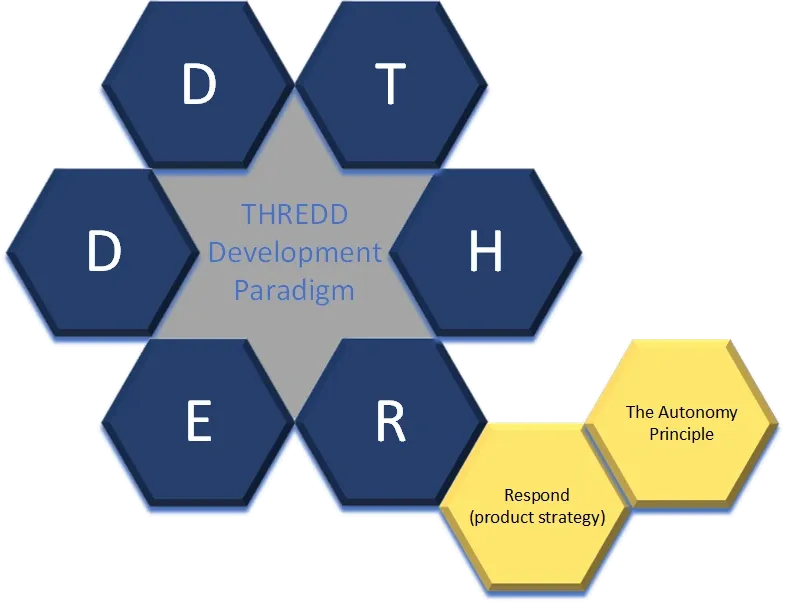
Now that you understand the importance of establishing of an environment conducive to learning and knowledge acquisition, supported by open communication, using the Ascendency and Connectivity Principles, lets turn our focus to execution. The third principle of the THREDD AI Paradigm is the Autonomy Principle in the product strategy domain. The key action here is 'Respond', an activity that every individual and team should strive for when any task is required. Language like, "I don't have the ability to do that", "I don't know that part of the code well enough", "I'm not a dev-ops person", "I need approval from...", "When did we start doing this?", doesn't exist in an autonomous team. Hearing these identify to you that knowledge and resource gaps exist. If you ignore these signs your team will stray farther and farther away from autonomy.
Your teams and individuals need to have all of the necessary resources, knowledge, and empowerment for decision making in order to execute on the product roadmap efficiently. In doing so, you will enable your developers to understand how the individual parts of the software they are building contribute and effect its delivery. Through understanding the larger strategic product initiatives your team will be better equipped to produce their best work. Also, communicating a clear product strategy allows your team to implement the most optimal well designed solutions that supports it. Since no organization delivers a product from inception to market following the exact plan drafted in their initial roadmap, there is a valuable opportunity to shape direction with the teams feedback.
Another sign of an autonomous team is one where you can remove any individual and the team can still complete the work without external help. There is also no concept of a best developer because everyone will be able to fulfill any need through ascendency and connectivity.
Imagine an intelligent agent with the know-how to determine and inform you that you have run out of milk. You may be thinking, "well that is nice to know", but I still have to go to the grocery store. Then you might think, "well, I would eventually notice I have run out of milk and then take a trip to purchase some". You might even question the value of this so called intelligent agent in the first place.
This is what its like to have a development team understand the 'what' and have no empowerment to respond with action guided by some well defined strategy. In this example, a strategy might be to check if there are 5 dollars in your wallet, then go to the grocery store, purchase the milk, carry it home, and store it on the second shelf in the door of your refrigerator. If you give the intelligent agent the ability to respond using this strategy, now this agent does several things for you. It drives your productivity, frees up more of your time, executes the strategy on your behalf, becomes an example for others to reproduce this task, becomes predictable and therefore measurable. I will circle back to this when I explain about the Predictability Principle, but for now I will just state that this is the importance of incorporating product strategy into a development model and without it you will never reach the goal of building an autonomous team.
The Autonomy Principle is limited by the Connectivity Principle and benefits the Solidarity Principle.
In other words the ability to 'RESPOND' is limited by the ability to 'HARMONIZE' and facilitates the ability to 'EMPATHIZE'.